The registration door is open. Why are entrepreneurs still standing outside?
In short
- The government made it easier to register a company this year: an online platform in July, and a circular that grants the commercial register as soon as the basic papers are in. More than 10,000 registrations were made in the first half of 2026.
- But at the EntreStations launch evening, 52% of those who answered said their company is not registered yet, and 76% agreed that registering early can do more harm than good.
- This is not mainly fear of paperwork: 83% say a handshake is not enough, even with your brother, and 63% have written contracts with clients. They only delay the paper that ties them to the state.
- Evidence from Sri Lanka and Benin says easier procedures are not enough: information and free registration barely moved business owners. Some moved only when paid directly or offered extra services, and even then most stayed unregistered.
- My conclusion: making registration easy is not measured in days to get a register. It is measured by stable rules, clear licensing after the register, and what a founder gains by registering.
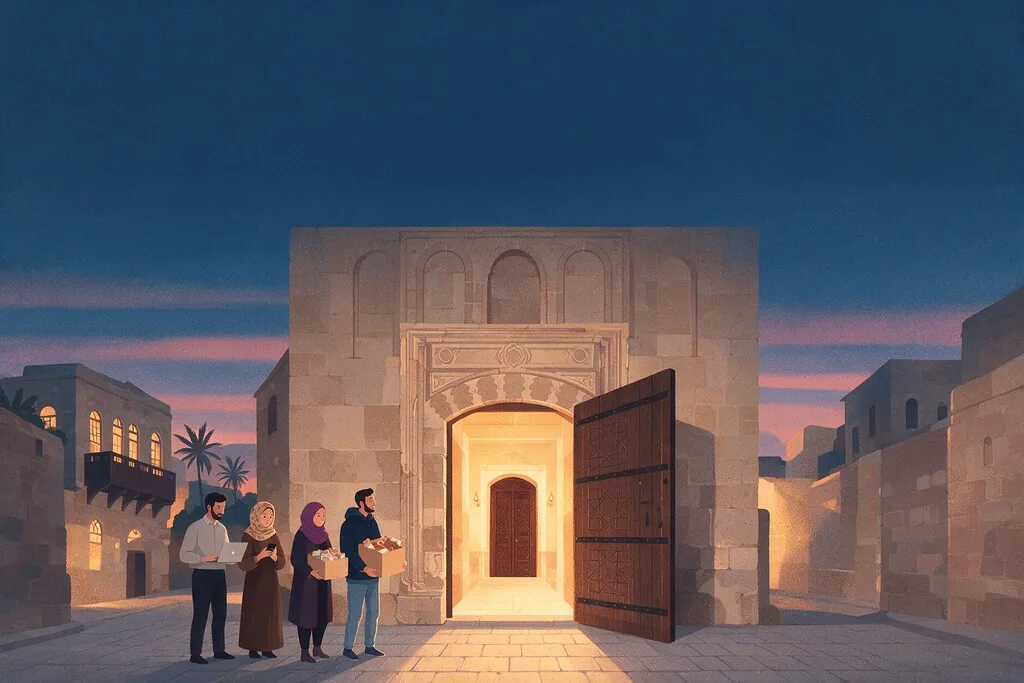
The first door is open. The second door inside is still closed.
registrations in the first half of 2026
applications accepted in the first month
have not registered their company yet
think registering early can hurt
Source: Ministry of Economy and Industry via SANA (2026), and the EntreStations launch evening poll (September 2026)
The door is getting wider, yet many still stand outside
On 7 July the Ministry of Economy and Industry launched company registration through its online portal. A few days later the minister issued a circular saying the commercial register should be granted the first time as soon as the basic papers are submitted, without waiting for approvals and licences. According to the ministry's figures, more than 10,000 registrations were made in the first half of the year, from single-owner registers to companies of every type, and initial registration on the platform takes five working days when the papers are complete.
These are real steps, and I am not writing this to play them down. But when I look at our own community, I see a different picture.
At the launch evening of EntreStations on 24 September, we asked the audience direct questions about their businesses through their phones. Here is what the 25 people who answered the registration question said:
Is your company officially registered?
- Registered
- Started the process
- Not yet
25 answers · EntreStations launch evening, 24 September 2026
What matters more than the share is the view behind it. We showed them the statement "Registering your company early can hurt you more than it helps", and 76% agreed.
Some would read this as fear of the state, or a wish to avoid taxes. But the answers from the same evening do not support that reading:
Paper with people, paper with the state
With clients and partners
With the state
23 to 25 answers per question · EntreStations launch evening, 24 September 2026
These people are not against paperwork. They write contracts and ask for them. They only delay the paper that ties them to the state. And a third of them do not even know how to register a trademark. That gap is worth understanding before we judge it.
A rule that changed twice in one week
We followed posts by founders and entrepreneurship organisations, and public sessions. From them, and from official news, we can draw this timeline:
Decision 70 raises the minimum capital for companies: 2.5 million new Syrian pounds for a limited liability company, and 20 million for a joint-stock company.
The decision is withdrawn in full and the old terms return, after objections from chambers of commerce and founders, according to Riyada+.
A circular unifies the work of company departments and commercial registries across all provinces.
A new ministry website lists the requirements of 259 services, all of which still need a visit in person, according to Riyada+.
Online company registration launches. In less than a month 65 applications arrive, and 13 reach acceptance.
The commercial register is granted as soon as the basic papers are in, with licences to follow, except for activities under a regulator.
More than 10,000 registrations in the first half of the year.
The overall direction is positive, that much is clear. But put yourself in a founder's shoes in January: you read that the cost of starting a company went up, then you read that it went back down, all within two days. What do you learn? You learn that the rule may change after you commit to it. And when the rule is not stable, waiting becomes a sensible choice, not laziness.
Riyada+ asked its followers that day whether decisions like this push founders into informal work or out of the country. The numbers from our evening, nine months later, suggest the question was the right one.
Is it enough to make registration easy?
World Bank researchers tested this question with field experiments, and their answer surprises anyone who thinks the procedures are the only obstacle.
Sri Lanka: even free registration barely moved anyone
Between 2008 and 2011, researchers from the World Bank and two universities split owners of small unregistered businesses into groups. The first group got a full explanation of how to register, and full repayment of the fees. The result: almost no effect. When owners were offered a payment equal to half a month to a full month of their profits if they registered, about one in five did. When the payment rose to two months of profits, nearly half did.
How many businesses registered in the Sri Lanka experiment?
De Mel, McKenzie and Woodruff, American Economic Journal: Applied Economics (2013). Businesses with 1 to 14 workers in the two largest cities.
And what happened to those who registered? Average profits went up, but because of a few businesses that grew fast. Most saw no change in income. But those who registered reported more trust in the state, mainly in local government. A reminder that trust runs both ways.
Benin: a simple, free legal status
In 2014 Benin launched a simple, free legal status for small business owners called the entreprenant. Information alone moved almost no one. The fullest package that came with it, with training, help to open a bank account and a go-between with the tax office, raised registration by only 16 points. The researchers found no clear effect of registering on business performance.
This same idea, a simple and temporary registration for new businesses, is something many in our community ask for under the name temporary register. Benin's experience does not say it is a bad idea. It says it is not enough on its own.
Our region
According to the International Labour Organization, 68.6% of work in the Arab States is informal. So we are not an exception. We are part of a wide pattern.
One of the researchers behind these experiments summed up what he learned over the years: most informal firms stay informal unless they are strongly pushed or paid to register. In other words, business owners do the maths. When the cost of registering is clearer than the benefit, they wait.
A register is one thing. A licence is another.
Much of the discussion rests on an assumption we rarely say out loud: that whoever gets a commercial register can now operate. That is true for a shop. It is not always true for a startup.
The July circular itself, the best step taken on this file, left out of the instant register activities under a regulator, including banks, money exchange, money transfers, insurance and insurance brokerage, medical expense management, real estate development, valuation and finance, and security services. These overlap with the sectors where fintech companies work, and with the e-payment and transfer services many apps rely on.
And in our community's discussions over almost two years, app licensing and the commercial register were the most repeated question, followed by e-payment questions. Worse, the answers to the same question often differed from one person to the next.
Door one: the commercial register
Who grants it?The Ministry of Economy and Industry
How long?Five working days on the platform, if the papers are complete
Where are the rules?On the online platform and the ministry website
Door two: the licence
Who grants it?A different regulator for each sector
How long?It varies from one body to another
Where are the rules?In our community's discussions, conflicting answers to the same question
So a founder does not face one door, but a second door after the first, and nobody knows exactly where its key is. When the first door alone will not get them to work, putting it off makes sense.
What does this mean?
- 01
For founders: separate protecting your business from registering your company
There can be good reasons to put off setting up a company. But putting off protecting your name and trademark, and writing down your agreement with your co-founders, is a different matter. At our evening, a third of respondents did not know how to register their trademark, and half of those with partners had not put the partnership on paper. These papers protect you from a partner or a competitor, not from the state. Ask a lawyer for the details.
- 02
For officials: stability matters more than speed
A decision issued and withdrawn within two days costs more trust than any shortcut saves. My suggestion: publish any decision that affects starting a company, or its cost, as a draft for a short consultation before it takes effect.
- 03
A public licensing guide
One page for each regulated sector: which body, which papers, how many days and how much it costs. That alone would answer half the questions that keep coming up in our community.
- 04
Give registration a benefit people can see
Sri Lanka and Benin show that easier procedures are not enough on their own, and that some people move when they see a direct benefit. The clearest benefit on offer today is e-payments and a company bank account. If registering became the easiest way to accept e-payments, it might attract more than any circular.
- 05
What we will do
We will add registration and licensing questions to the weekly EntreStations sessions, and to the second edition of the Entrepreneurship Observatory in April 2027, so we can measure on a larger sample instead of guessing.
What delays registering or licensing your business the most?
Sharper numbers next time
Every EntreStations session adds new answers to these numbers. Book a seat at the next session, or join the Union.
References and method
EntreStations
The source of the registration, contract and trademark numbers in this article.
Programme page → Local sourceRiyada+
The source for the withdrawal of Decision 70 and the ministry services.
facebook.com/riyadaplus → Earlier readingOpportunity or necessity?
What our data says about why entrepreneurs in Syria start their businesses.
Read the article →Syrian sources
- SANA (August 2026). Companies registered on the online company platform (in Arabic). sana.sy
- CNBC Arabia (July 2026). New steps to make online company registration easier (in Arabic). cnbcarabia.com
- Enab Baladi (30 March 2026). Circular unifying company departments and the commercial registry (in Arabic). enabbaladi.net
- MENA Startup Digest (January and August 2026). Higher minimum capital, and 65 applications on the platform. Decision 70 · Platform
- Riyada+ (2026). Facebook posts of 17 January and 29 June 2026 (in Arabic). Decision 70 withdrawn · Ministry services
- Association of Syrian Entrepreneurs (2026). EntreStations launch evening poll, 24 September 2026. aosen.org
Global studies
- de Mel, S., McKenzie, D., & Woodruff, C. (2013). The Demand for, and Consequences of, Formalization among Informal Firms in Sri Lanka. American Economic Journal: Applied Economics, 5(2), 122-150. doi.org/10.1257/app.5.2.122
- Benhassine, N., McKenzie, D., Pouliquen, V., & Santini, M. (2018). Does inducing informal firms to formalize make sense? Experimental evidence from Benin. Journal of Public Economics, 157, 1-14. World Bank paper · blog
- International Labour Organization (2018). Women and Men in the Informal Economy: A Statistical Picture, 3rd ed. Summary
About these numbers
- Event poll
- The EntreStations launch evening on 24 September 2026, with 41 phones taking part. The audience came by private invitation and were not all founders. Each question had 16 to 25 answers, so one person is 4 to 6% of a result. We read the numbers as a direction, not a measurement, and the statements measure opinion, not practice.
- Community talks
- The "Entrepreneurs Gathering" group, January 2025 to October 2026. We ranked topics by how often they came up, with no quotes or names.
- Riyada+
- The page's posts between May 2025 and October 2026, including the withdrawal of Decision 70 and the ministry services.
- Official figures
- Ministry of Economy and Industry statements as published by SANA.
- Global studies
- Sri Lanka and Benin are peer-reviewed studies of other countries, so the comparison is a guide only.
- Transparency
- The author is the Secretary General of the Association, and the Association signed a media cooperation agreement with Riyada+ in August 2025.
Frequently asked questions
Short answers about registering a company in Syria.
How long does it take to register a company in Syria today?
According to the Companies Directorate at the Ministry of Economy and Industry, initial registration on the online platform launched on 7 July 2026 takes five working days when the papers are complete and correct.
What is the difference between a commercial register and a licence?
The commercial register gives a business legal existence with the Ministry of Economy. A licence is an approval from the body in charge of a sector to carry out a given activity, such as financial or medical services. A business may need both to operate.
Why do many founders not register their companies early?
In a Syrian Entrepreneurs Union poll (September 2026), 76% agreed that registering early can do more harm than good. International evidence suggests owners weigh the cost of registering against its benefit, and that unstable rules raise that cost.
Does formal registration raise small business profits?
Not always. In Sri Lanka average profits rose thanks to a few businesses that grew fast, while most saw no change in income. In Benin, researchers found no clear effect of registering on business performance.
What is a temporary register?
A simplified, time-limited official registration that founders ask for, so a new business can start before meeting every requirement of the full commercial register. Benin's experience suggests it helps more when it comes with services and a clear benefit.

Ahmad Nahas
Secretary General of the Association of Syrian Entrepreneurs and co-founder of the agency Mesh-Mosh. He founded Harbuk, Syria's first integrated e-commerce platform, and documented the experience in his book Harbuk: A startup in the world's most volatile market.
More about the author